

In modern precision machinery design, space saving, lightweight structure and stable running accuracy have become core optimization indicators for equipment upgrading. Traditional standard bearings often fail to meet the installation and performance requirements of compact and miniaturized equipment due to their fixed proportional cross-section size. As a specialized precision component, thin section bearings have broken the structural limitations of ordinary bearings, becoming the preferred supporting part for high-end precision transmission equipment in various industries.

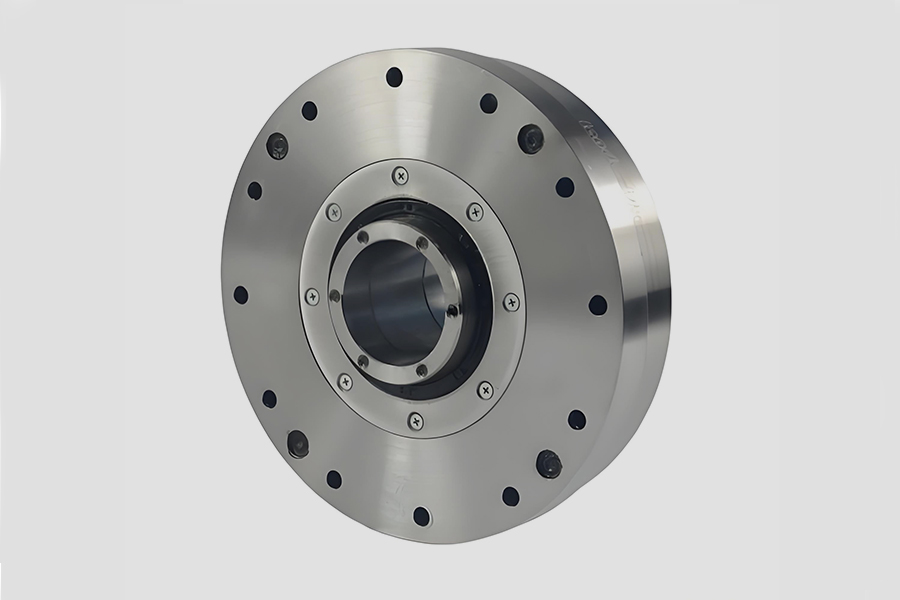
Different from conventional bearings whose wall thickness increases with the bore diameter, thin section bearings adopt a constant cross-section design. Whether it is a small-bore or large-bore model, the bearing maintains an ultra-thin and uniform wall thickness, which greatly reduces the overall weight and occupied space of the assembly. This unique structural feature allows equipment designers to reserve more space for internal wiring, pipelines and other functional components while ensuring structural stability, realizing a more compact and integrated equipment structure.
In terms of product classification, mainstream thin section bearings on the market are mainly divided into three core types: radial contact type, angular contact type and four-point contact type. Each type has targeted performance advantages and application scenarios. Radial contact thin section bearings are suitable for working conditions with single radial load and low friction requirements, featuring smooth operation and low running noise. Angular contact models can bear combined radial and axial loads, with excellent positioning accuracy, adapting to high-speed and high-precision rotating scenarios. Four-point contact thin section bearings stand out for their strong overturning moment resistance, capable of bearing multi-directional composite loads, and are widely used in rotary structures with complex force conditions.
Manufactured with high-purity bearing steel and precision grinding technology, qualified thin section bearings achieve extremely low dimensional tolerance and roundness accuracy. Strict heat treatment processing enhances the structural rigidity and wear resistance of the bearings, effectively avoiding deformation and precision attenuation during long-term cyclic operation. Even in frequent forward and reverse rotation, intermittent start-stop operation and long-duration low-speed rotation scenarios, the bearings can maintain stable running precision and consistent friction torque, ensuring the long-term reliable operation of precision equipment.
The application scenarios of thin section bearings cover multiple high-precision manufacturing fields, with strong industry adaptability. In precision automation equipment, they are applied to rotary positioning tables, miniature transmission mechanisms and automated handling modules, helping equipment achieve zero-backlash precise transmission. In optoelectronic and precision detection instruments, the ultra-compact size and micro-vibration operation characteristics of thin section bearings ensure the detection accuracy of optical scanning and precision measuring equipment.
In semiconductor production equipment, thin section bearings meet the strict clean-room operation standards with low particle emission and stable precision, and are used in wafer transfer arms and precision positioning platforms. In addition, they are also widely matched with harmonic reducers and small precision transmission components, serving lightweight rotary joints of automated equipment, effectively reducing the overall equipment inertia and improving motion response efficiency.
Compared with ordinary bearings, the core advantages of thin section bearings in engineering applications are very prominent. Their lightweight design effectively reduces the operating load and energy consumption of equipment; the constant cross-section structure simplifies the overall mechanical design and reduces assembly difficulty; and the high-precision and high-rigidity performance avoids positioning errors caused by bearing deformation. For modern mechanical equipment that pursues miniaturization, high precision and energy saving, thin section bearings have become an indispensable core precision component.
With the continuous upgrading of precision manufacturing industry, the market demand for thin section bearings with higher accuracy, longer service life and stronger environmental adaptability is increasing. Optimized material formula and refined processing technology will further expand the application boundaries of thin section bearings, providing more reliable precision support for high-end automation, optoelectronic detection, semiconductor equipment and other fields.


We are a bearing manufacturing enterprise that integrates research and development, design, production, and sales.
© Copyright Hebei Tianma Bearing Manufacturing Co., Ltd 2026 © All Rights Reserved. sitemap